
What is ESD?
WHAT IS STATIC ELECTRICITY?
Static electricity refers to electrical charge at rest. It is an electrical imbalance on the surface of a material interacting with its surroundings. This imbalance occurs when an atom or molecule loses or gains electrons. Normally, an atom contains equal numbers of protons and electrons, but electrons can move easily from one atom to another.
Static electricity can arise naturally when two materials—similar or different, conductive or insulating—come into contact and then separate, or rub against each other. Electrons transfer across the contact surface. The electrical characteristics of this interface differ from those of either material. When the materials separate, the interface disappears, leaving an excess of electrons (negative charge) on one material and a shortage of electrons (positive charge) on the other. These opposite charges attract each other and may discharge through an insulating medium such as air, producing an arc or spark. Such arcing can be extremely dangerous in certain environments. “Static” is a relative term: the charge dissipates gradually over time, at a rate that depends on the material’s resistance. Plastic and iron are examples. Because plastic has very high electrical resistance, it can retain static charge for a long time.
Iron, by contrast, retains a charge for an almost imperceptibly short time because of its low electrical resistance. The static electricity accumulated on a material depends on two factors:
- 1. Amount of charge on the material
- 2. Capacitance of the material
Consequently, even a small charge applied to a material with low capacitance can produce a high voltage. Because plastic has low capacitance, a small charge can generate a high voltage. Two forms of static electricity can be distinguished: volumetric and surface. Volumetric static charge develops within the bulk of a material, whereas surface static charge is present on its outer surface. Industrial problems involving static electricity are primarily associated with surface charge. If this charge could be stored in a suitable capacitor system, it could meet a significant portion of Türkiye’s energy needs.
ESD (electrostatic discharge) occurs when an electrical charge is transferred between two objects at different electrical potentials. Electrostatic discharge can occur wherever static electricity is present. Electrostatics covers physical phenomena ranging from the beating of the human heart and the interaction of charges within atoms to lightning. Lightning is the greatest example of static electricity: when positively and negatively charged clouds approach one another, nature’s largest electrostatic discharge occurs. Studies conducted in Japan put the average measured lightning discharge at around 15–20 MV. The tingling sensation sometimes felt when walking barefoot on carpet is caused by static charge. Frequent contact with materials in the workplace can also transfer charge to the body. People can accumulate static electricity through friction while walking, getting in and out of vehicles, contact with their workbench, or putting on and taking off clothing.
HARMFUL EFFECTS OF STATIC CHARGES
As electronics manufacturers saw failures occurring in their devices and components and recognized the seriousness of the risk, a CENELEC committee on electronic devices was established in Europe in the late 1980s to improve quality processes and protect electronic components with sensitivity thresholds above 100 V from potential ESD damage.
The static electricity that people accumulate harms both their health and the electronic devices they use. When handling or transporting electronic devices, people knowingly or unknowingly discharge this static charge into circuit components. Such electrostatic discharge can render the equipment unusable or shorten its service life.
Sudden changes in electrostatic charge can cause unwanted failures in circuit elements, components, assemblies and advanced-technology products, reducing product quality. Devices susceptible to ESD include transistors, diodes, laser diodes, electro-optical devices, precision film resistors, thin-film and thick-film resistors, capacitors, various semiconductors, microcircuits, hybrid devices, piezoelectric crystals and highly integrated circuits.
Antistatic equipment intended to protect electronic devices should not discharge abruptly; it should provide a gradual, controlled path to ground. Conductors with a surface resistance of 103 Ω or less discharge very rapidly. Materials between 104 and 105 Ω also discharge quickly. Materials with a surface resistance between 106 and 1012 Ω are the true antistatic materials: because they discharge gradually, they do not damage components and they also protect people. Materials above 1012 Ω are insulators and are not used.
Measures for preventing electrostatic discharge are set out in various standards. Many are based on establishing an Electrostatic Protected Area (EPA). In principle, this means excluding materials and items that can accumulate large electrostatic charges near sensitive circuits and providing appropriate grounding for electronic equipment and personnel working with it.
Damage caused by electrostatic discharge:
• High costs
• Poor product quality
• Equipment failure, especially at critical moments,
These are some examples. Protecting devices and systems against electrostatic discharge at relatively low cost reduces maintenance, repair, replacement parts, labor and downtime costs.
PREVENTIVE MEASURES
• All work areas must be clearly marked with visible ESD symbols and signs. Personnel must be warned before entering an ESD-protected area.
• Required insulation and isolation measures are intended to prevent electron flow through conductors. This also relates to the use of ionization systems.
• Personnel and visitors entering the work area must be grounded with wrist straps and/or heel straps, gloves or finger cots, and must always wear ESD smocks.
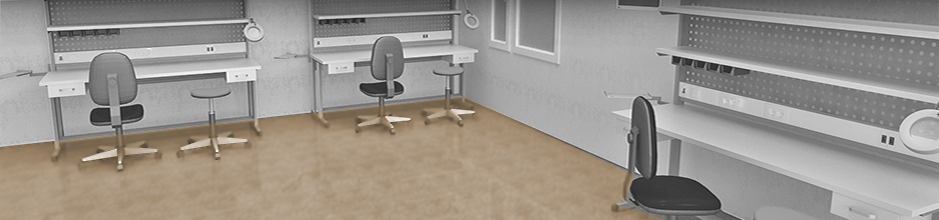
• ESD-safe repair and maintenance workbenches and chairs should be used.
• Furniture made with antistatic wood and fabrics should be preferred.
FURNITURE
ESD-safe chairs and workbenches allow static charge to dissipate to ground. The antistatic construction extends from the chair backrest to its casters, so charges generated at different points of a chair or stool can be conducted to ground. On technical service benches, ESD laminate and ESD paint allow charge to dissipate from the worktop, shelves, frame, legs or casters through a 1 MΩ resistor at low current. Grounding terminals on the bench are also important for ESD-protection accessories such as wrist straps.
FLOORING APPLICATIONS
Flooring is the most important part of an ESD installation. PVC, carpet and paint options are available. Antistatic and conductive floor coverings are used to reduce or eliminate static electricity caused by friction or by electronic devices by draining the charge to ground.
OTHER
Wrist straps, heel straps, ESD-safe office supplies, antistatic liquids and many other accessories should be used to protect against electrostatic discharge when working with electronic components and explosives.
RELATED LINKS
ESD Handbook
ESDA
The Prevention and Control of Electrostatic Discharge (AN40-005)
Charleswater ESD Awareness Booklet
Static Electricity